
Apple’s MacBook lineup changed dramatically in 2026 with the introduction of the MacBook Neo, a much lower-cost MacBook designed to bring macOS to more users than ever before. Starting around $599, the Neo immediately became one of the most talked-about laptops in the industry because it finally gave consumers a true budget MacBook option. At the same time, Apple also released the new M5 MacBook Air, which continues to sit in the middle of Apple’s laptop lineup as the company’s mainstream premium laptop. For many buyers, the question is no longer whether to buy a MacBook at all, but whether the MacBook Neo is “good enough” or if the M5 MacBook Air is still worth spending hundreds more for.
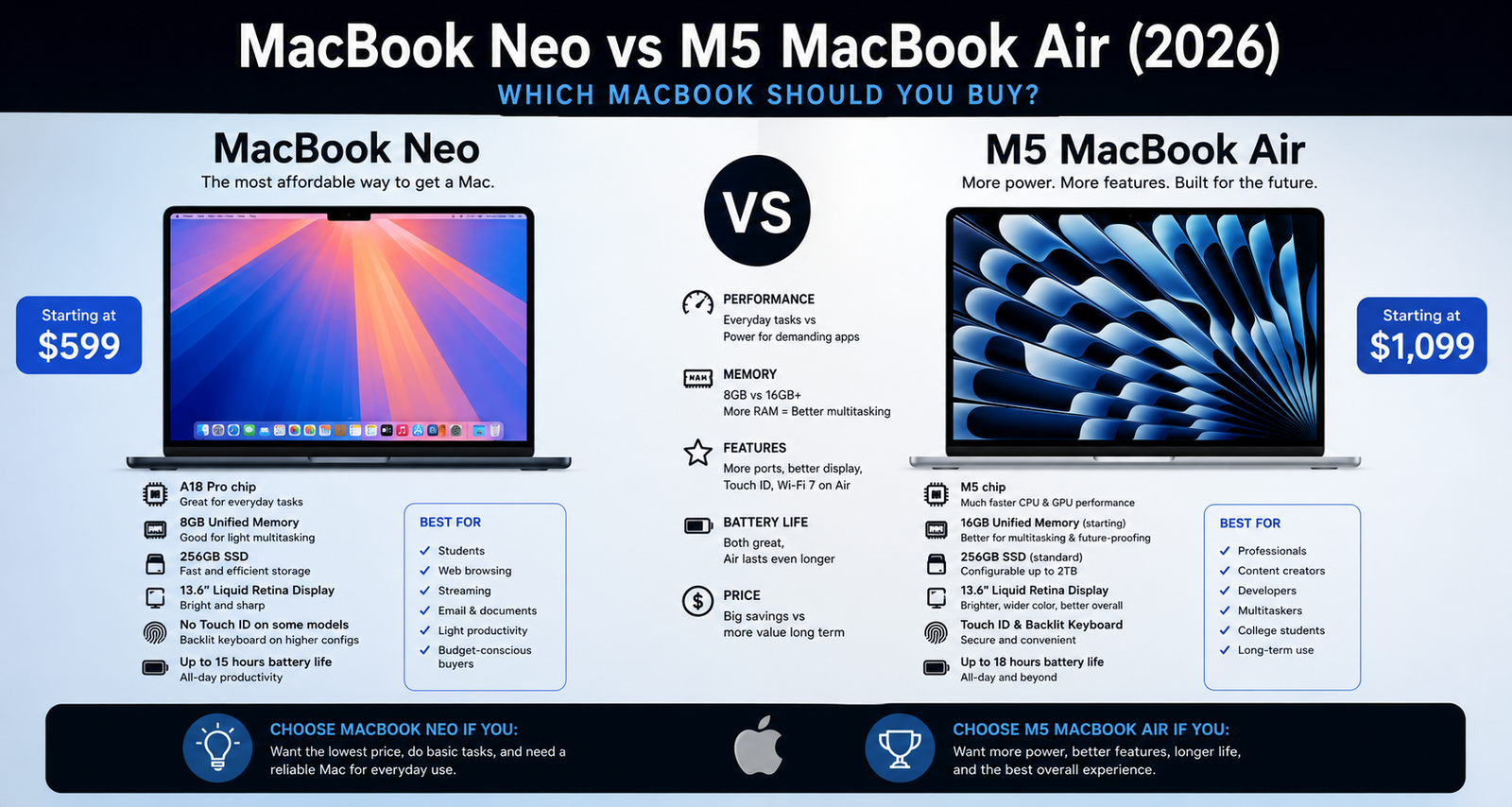
The biggest difference between these two laptops is performance and long-term capability. The MacBook Neo uses an A18 Pro chip derived from Apple’s iPhone processors, while the MacBook Air uses Apple’s full desktop-class M5 chip. The Neo is surprisingly fast for everyday tasks and can easily handle web browsing, email, streaming, office work, and light productivity. However, the M5 MacBook Air is significantly more powerful for sustained desktop workloads, multitasking, creative applications, coding, and future AI-driven software. Benchmarks and reviews consistently show the M5 Air outperforming the Neo in both CPU and graphics workloads.
Memory is another major factor separating these two Macs. Most MacBook Neo models are limited to 8GB of RAM, while the M5 MacBook Air starts at 16GB and can be configured much higher. In 2026, memory matters more than ever because modern applications, browsers, AI tools, and multitasking workflows consume enormous amounts of RAM. Users planning to keep their laptop for five years or longer will likely benefit substantially from the additional memory offered by the MacBook Air. Many reviewers now argue that 16GB has effectively become the new minimum recommendation for long-term laptop ownership.
The MacBook Air also delivers a noticeably more premium overall experience. It includes faster USB4 and Thunderbolt support, better external display support, a brighter and more feature-rich display, improved speakers, longer battery life, and better overall connectivity. The Air also includes Touch ID and a backlit keyboard on all models, while some lower-end Neo models lack these features entirely. The M5 Air additionally supports Wi-Fi 7 and offers more storage and memory upgrade options. For professionals, students in demanding programs, content creators, developers, and serious multitaskers, these improvements can make a major difference in day-to-day use.
That said, the MacBook Neo exists for a reason, and for many users it may actually be the smarter purchase. Apple designed the Neo to target students, casual users, Chromebook buyers, and people who simply want a reliable MacBook at the lowest possible price. For someone primarily browsing the web, watching YouTube, checking email, attending Zoom meetings, and using light productivity apps, the Neo can feel surprisingly close to the experience of a more expensive MacBook Air. Apple’s efficiency with macOS and Apple Silicon allows the Neo to perform much better than most people would expect from a budget laptop.
Price is ultimately what makes this comparison so difficult. The MacBook Neo starts roughly $500 cheaper than the M5 MacBook Air, which is a massive difference in the laptop market. For budget-conscious buyers, students, families, and people buying a secondary laptop, the Neo offers tremendous value. It gives users access to the Apple ecosystem, macOS, iCloud integration, Apple apps, and solid everyday performance at a price point Apple has never offered before. Some reviewers even consider it one of the best-value laptops Apple has ever released.
However, if your workload includes video editing, photo editing, software development, multitasking with many apps, AI workloads, virtualization, or heavy long-term productivity, the M5 MacBook Air is absolutely the better machine. The Air is not simply faster today — it will likely remain useful much longer into the future. As macOS continues evolving and Apple integrates more AI features directly into the operating system, the additional power and memory headroom of the M5 Air could become increasingly important over time.
For most buyers, the decision comes down to budget versus longevity. The MacBook Neo is ideal for users who want the cheapest possible MacBook and mainly perform light everyday tasks. The M5 MacBook Air is the better choice for users who rely heavily on their laptop for work, creative projects, multitasking, or future-proofing. Both laptops are excellent in their own categories, but they target very different audiences. The Neo is Apple’s new affordable entry point into macOS, while the M5 MacBook Air remains the best overall MacBook for most people who want a balance of portability, power, battery life, and long-term performance.