
Apple recently raised prices across much of its Mac lineup, with some models increasing by several hundred dollars. In June 2026, for example, the 512GB MacBook Air reportedly rose from $1,099 to $1,299, while a 1TB MacBook Pro increased from $1,699 to $1,999. The M4 Pro Mac mini climbed by $200, and higher-end Mac Studio configurations received even larger increases. Although tariffs, manufacturing expenses and Apple’s profit targets may all play a part, rapidly rising prices for RAM and SSD storage appear to be among the biggest reasons for these changes.
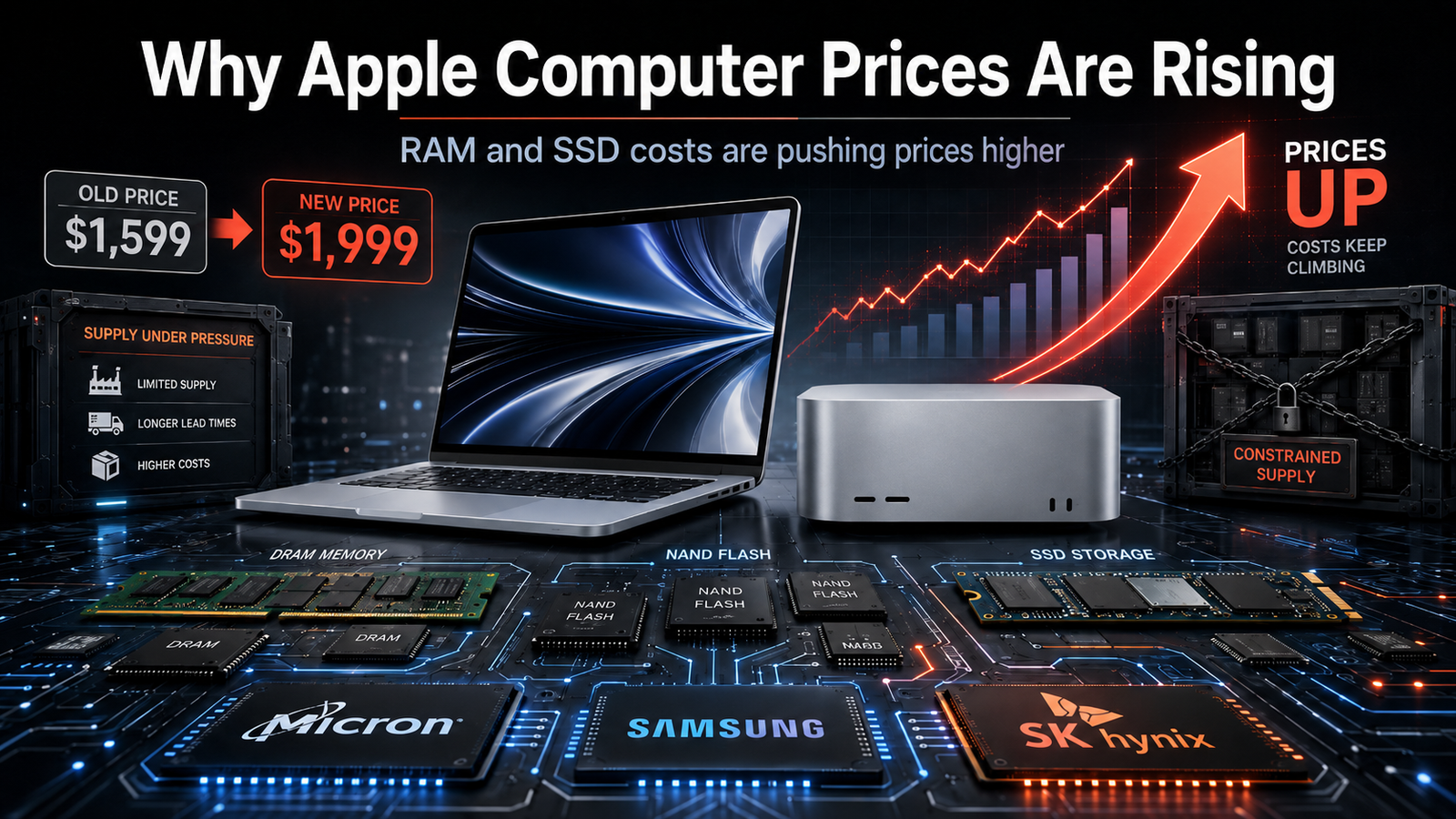
Every modern Mac contains two components that are especially sensitive to market conditions: unified memory and NAND flash storage. Unified memory performs the work normally handled by system RAM and graphics memory, while NAND flash is used inside the Mac’s SSD. Apple builds these components into the computer rather than making them easily replaceable, so their cost is included at the time the Mac is manufactured. When memory and storage prices rise, Apple must either absorb the extra expense, reduce its profit margin or pass at least some of the increase on to customers.
The RAM market is highly concentrated, with Samsung, SK Hynix and Micron supplying most of the world’s DRAM. Recent market estimates placed Samsung at approximately 39% of the DRAM market, SK Hynix at 26% and Micron at 25%. Together, those three companies accounted for roughly 90% of the market. This does not necessarily mean they secretly coordinate prices. However, because there are so few major suppliers, decisions made by any one of them about production, investment or customer allocation can have a substantial effect on worldwide availability and pricing.
Artificial intelligence is one of the main forces disrupting the memory market. AI servers require enormous quantities of high-bandwidth memory, conventional DRAM and fast storage. Samsung, SK Hynix and Micron can often earn more by directing manufacturing capacity toward expensive server and AI memory than toward lower-cost memory for consumer computers. Even though the memory used in a Mac is not identical to the HBM installed beside an AI accelerator, the products compete for engineering resources, manufacturing equipment, capital investment and portions of the same broader supply chain.
This shift toward AI products has tightened the supply of conventional memory used in laptops, desktops and smartphones. Industry estimates at the beginning of 2026 projected that conventional DRAM contract prices could rise by approximately 55% to 60% in the first quarter alone, while NAND flash prices could increase by roughly 33% to 38%. By the third quarter, TrendForce was still describing DRAM supplies as extremely constrained and expected contract prices to rise another 13% to 18% from the previous quarter.
SSD pricing has been affected for many of the same reasons. NAND manufacturers previously reduced production and capital spending after a period of weak demand and oversupply. When demand recovered—particularly from data centers and AI infrastructure—the industry did not have enough immediately available capacity to respond. New semiconductor factories cost billions of dollars and can take years to construct, equip and qualify, so suppliers cannot quickly increase output whenever demand suddenly rises.
Apple is also more exposed to these increases because it now sells most Macs with larger amounts of memory than it did several years ago. A modern Mac may include 16GB or more of unified memory as standard, while professional models can be configured with far greater capacities. Storage configurations of 512GB, 1TB, 2TB and beyond are also increasingly common. A percentage increase in component costs becomes much more significant when a computer contains a large amount of memory and storage, which helps explain why some of the largest price increases appeared on higher-end Mac configurations.
It would be misleading to say that Micron, Samsung and SK Hynix can simply choose any price they want. They still compete with one another, negotiate contracts with large customers and face pressure from other suppliers, including growing Chinese memory manufacturers. Nevertheless, their dominant market positions give them considerable pricing power when supplies are limited. By prioritizing more profitable AI memory, limiting rapid production expansion and negotiating long-term supply agreements, the major manufacturers can keep the market tighter than it would be during a traditional period of oversupply.
Mac prices could rise again if DRAM and NAND shortages continue into 2027. Industry analysis in mid-2026 indicated that demand was still exceeding supply across HBM, DRAM and NAND, with some constraints potentially lasting beyond the end of the year. Additional tariffs, currency changes, transportation costs or disruptions involving semiconductor factories could put even more pressure on Apple. On the other hand, weaker computer and smartphone sales could eventually reduce demand and cause memory prices to stabilize or fall.
For Mac buyers, the immediate outlook suggests that the era of steadily improving specifications at unchanged prices may be temporarily on hold. Apple may offer sales through retailers, adjust entry-level configurations or negotiate favorable long-term contracts with suppliers, but it cannot completely avoid a worldwide increase in component costs. Unless memory production catches up with AI-driven demand, Macs with larger amounts of RAM and SSD storage are likely to remain expensive—and another round of selective price increases cannot be ruled out.