
Buying a graphics card right now is not as simple as picking the newest model or the one with the biggest number on the box. GPU prices are still moving around, some cards are selling above their original launch prices, and the “best” graphics card depends heavily on what you are actually trying to do.
Are you gaming at 1080p? Do you want 1440p at high refresh rates? Are you trying to play at 4K? Do you care about ray tracing? Are you using the card for video editing, streaming, AI, or creative work? Those questions matter more than just buying the most expensive card you can afford.
Here is a practical breakdown of what graphics card you should buy right now based on price, performance, and real-world use.
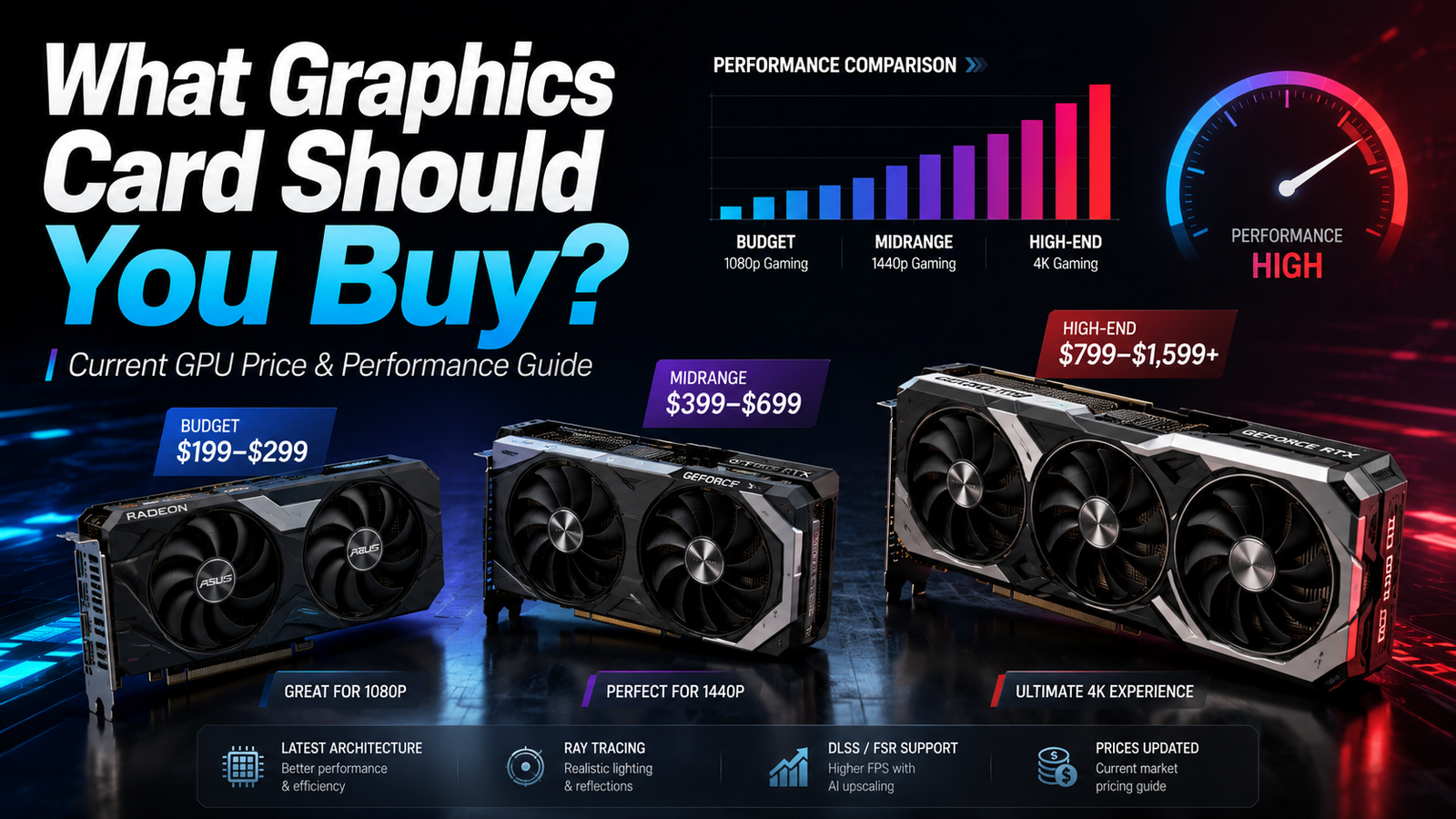
Best Budget Graphics Card: Intel Arc B570 or Nvidia RTX 5050
If you are building a budget gaming PC and want to keep the GPU around the $250 range, the two cards to look at are the Intel Arc B570 and Nvidia RTX 5050.
The Intel Arc B570 is one of the cheapest modern GPUs worth considering. It usually sits around the low-to-mid $200 range and gives you enough performance for 1080p gaming, especially if you are not trying to max out every setting. It also gives you 10GB of VRAM, which is nice at this price point.
The downside is that Intel GPUs are still not as consistent as Nvidia or AMD across every game. Driver support has improved a lot, but if you want the least amount of hassle, Nvidia still has the advantage.
That is where the RTX 5050 comes in. It is not a powerhouse, but it is a good basic 1080p card. It gives you Nvidia features like DLSS, better ray tracing support than most budget AMD or Intel cards, and generally more consistent performance across games.
Who should buy this class of card?
This is for someone who plays at 1080p, mostly plays esports games, older games, lighter titles, or does not mind turning some settings down. Think Fortnite, Rocket League, Valorant, Minecraft, indie games, and casual AAA gaming at medium settings.
Best pick: RTX 5050 if you want the easiest experience. Intel Arc B570 if you want to save money and are comfortable with Intel’s software ecosystem.
Best Lower-Midrange GPU: Radeon RX 9060 XT 8GB
For most budget-conscious gamers, the Radeon RX 9060 XT 8GB is one of the most interesting cards right now. It usually costs around $350, and for 1080p gaming, it offers a very strong mix of price and performance.
The RX 9060 XT is especially good if you care more about traditional gaming performance than ray tracing. In many games, AMD gives you more raw performance for the money, and that makes this card a strong choice for someone who wants a modern GPU without spending $500 or more.
The main thing to watch is VRAM. The 8GB model is fine for 1080p today, but some newer games are already starting to push past 8GB when you use ultra textures or higher resolutions. So, if you plan to keep your graphics card for several years, you may want to consider the 16GB version.
Who should buy it?
This is a good card for 1080p gamers who want high settings, good frame rates, and solid value. It is not the best choice for heavy ray tracing or serious 4K gaming.
Best pick: RX 9060 XT 8GB if you want the best price. RX 9060 XT 16GB if you want more long-term comfort.
Best Value 1440p Graphics Card: Radeon RX 9070
If you are gaming at 1440p, the Radeon RX 9070 is one of the best cards to look at right now. It usually costs around $600, which is not cheap, but it delivers strong performance and comes with 16GB of VRAM.
That 16GB matters. Modern games are getting larger, textures are getting heavier, and 1440p gaming is becoming the sweet spot for a lot of PC gamers. Compared to some Nvidia cards in the same class, AMD’s extra VRAM makes the RX 9070 feel like a safer long-term buy.
The RX 9070 is a great choice if you want high settings at 1440p and do not want to jump all the way into the very expensive high-end GPU market.
The downside is ray tracing. AMD has improved, but Nvidia still has the edge in ray tracing, DLSS, frame generation, and overall software support. So, if you play a lot of games with heavy ray tracing, Nvidia may still be worth considering.
Who should buy it?
This is the card for someone who wants excellent 1440p gaming, strong VRAM, and better value than many Nvidia options.
Best pick: Radeon RX 9070 for 1440p gaming if you want the best mix of performance, VRAM, and price.
Best 1440p With Nvidia Features: GeForce RTX 5070
The RTX 5070 is a strong alternative to the RX 9070, especially if you care about Nvidia’s software features. It usually competes closely with the RX 9070 in many games, but it has less VRAM, typically 12GB instead of 16GB.
That does not automatically make it bad. Nvidia has a major advantage with DLSS, ray tracing, frame generation, and creator software support. If you use Adobe Premiere, Blender, DaVinci Resolve, streaming software, AI tools, or anything that benefits from CUDA, Nvidia can be the better choice even if the AMD card looks stronger on paper.
The RTX 5070 is also a better choice if you like turning on ray tracing and using upscaling to keep frame rates high.
Who should buy it?
Buy the RTX 5070 if you want 1440p gaming but also care about ray tracing, DLSS, content creation, streaming, or AI workloads.
Best pick: RTX 5070 if Nvidia’s software features matter more to you than having 16GB of VRAM.
Best High-End Value GPU: Radeon RX 9070 XT
The Radeon RX 9070 XT is one of the best high-end value cards right now. It usually sits around the upper $600 range, though pricing can move depending on sales and stock.
Performance-wise, this is a strong 1440p ultra card and a reasonable entry-level 4K card. If you want to play at 4K without spending $1,000 or more, the RX 9070 XT is one of the most practical choices.
It also comes with 16GB of VRAM, which is important for higher resolutions. At 4K, VRAM becomes much more important, especially in newer games with high-resolution textures.
The RX 9070 XT is not perfect. Nvidia still wins in ray tracing and has stronger upscaling support in more games. But for traditional gaming performance, the RX 9070 XT gives you a lot for the money.
Who should buy it?
This is a great card for someone who wants 1440p ultra settings or 4K gaming without going into the extremely expensive RTX 5080 or RTX 5090 range.
Best pick: RX 9070 XT if you want the best high-end value and do not need Nvidia’s full feature set.
Best Nvidia High-End Choice: GeForce RTX 5070 Ti
If you want a high-end Nvidia card but do not want to spend RTX 5080 or RTX 5090 money, the RTX 5070 Ti is probably the card to look at.
This card is strong for 1440p, very good for ray tracing, and can handle 4K gaming with help from DLSS. It is also a better choice than AMD if you care about creator apps, AI software, streaming, or anything that benefits from CUDA.
The issue is price. The RTX 5070 Ti is often not cheap, and depending on the current street price, it may or may not be a good value. If it is close in price to the RX 9070 XT, you have a real decision to make. If it is much more expensive, AMD starts to look better for pure gaming.
Who should buy it?
Buy the RTX 5070 Ti if you want strong 1440p and 4K gaming, better ray tracing, Nvidia DLSS, and better support for creative or AI workloads.
Best pick: RTX 5070 Ti if you want Nvidia features and do not want to pay RTX 5080 prices.
Best 4K Graphics Card: GeForce RTX 5080
The RTX 5080 is for people who are serious about 4K gaming. It is expensive, but it gives you strong 4K performance, excellent ray tracing, and Nvidia’s best gaming software features outside the RTX 5090.
For many people, though, the RTX 5080 is hard to justify. It can cost around $1,000 or more, and once you get into this price range, the value drops fast. You are paying a lot more money for a smaller jump in real-world gaming performance.
Still, if you have a 4K monitor, want high settings, care about ray tracing, and want DLSS to carry you for the next few years, this is one of the best cards to buy.
Who should buy it?
This is for serious 4K gamers, high-end PC builders, and people who want strong ray tracing performance without jumping to the ultra-expensive RTX 5090.
Best pick: RTX 5080 if you want high-end 4K gaming and can afford it.
Best “Money Is No Object” GPU: GeForce RTX 5090
The RTX 5090 is the fastest consumer graphics card, but that does not mean most people should buy it.
This card is extremely expensive, power-hungry, and overkill for most gamers. If you are playing at 1080p or 1440p, it makes very little sense. Even at 4K, the RTX 5080 or RX 9070 XT may be a smarter buy depending on the games you play.
Where the RTX 5090 makes sense is for people who need the absolute best performance. That could mean 4K high refresh rate gaming, heavy ray tracing, 3D rendering, AI workloads, video production, or someone who simply wants the fastest card available.
Who should buy it?
Buy the RTX 5090 only if budget is not a concern or if you have workloads that can actually use that much GPU power.
Best pick: RTX 5090 for extreme performance, not value.
What About Used Graphics Cards?
Used GPUs can still be a great way to save money, but you need to be careful. Cards like the RTX 4070 Super, RTX 4080 Super, RX 7800 XT, RX 7900 XT, and RX 7900 XTX can be excellent if you find them at the right price.
The problem is that used prices are not always low enough to make sense. Sometimes a used last-generation card costs almost as much as a new current-generation card with better features, a warranty, and better efficiency.
As a general rule, only buy used if the price is meaningfully lower than a comparable new card. Also make sure the card was not abused, mined on heavily, or sold without any kind of return window.
Quick Buying Guide
For 1080p gaming on a budget, look at the RTX 5050, Intel Arc B570, or RX 9060 XT 8GB.
For better 1080p and entry-level 1440p, the RX 9060 XT 16GB is a strong choice if the price is right.
For the best 1440p value, the Radeon RX 9070 is one of the best options.
For 1440p with Nvidia features, ray tracing, DLSS, and creator support, choose the RTX 5070.
For high-end 1440p and affordable 4K, the RX 9070 XT is one of the best buys.
For Nvidia high-end gaming without going completely crazy, the RTX 5070 Ti is a strong option.
For serious 4K gaming, the RTX 5080 is the card to look at.
For the fastest possible consumer GPU, the RTX 5090 is the top card, but it is not the best value.
Final Recommendation
If I had to pick one graphics card for most people right now, I would start with the Radeon RX 9070. It gives you excellent 1440p performance, 16GB of VRAM, and better long-term value than many cards around the same price.
If you want the best value for 4K gaming, the Radeon RX 9070 XT is very hard to ignore.
If you care about ray tracing, DLSS, AI, video editing, or content creation, then Nvidia becomes more attractive. In that case, the RTX 5070 or RTX 5070 Ti would be the smarter choice, depending on your budget.
The biggest mistake is buying more GPU than you actually need. If you are gaming at 1080p, you do not need a $1,000 graphics card. If you are gaming at 1440p, you probably do not need an RTX 5090. Match the graphics card to your monitor, your games, and your budget, and you will get a much better deal.