
The Apple Mac mini M4 quickly became one of the most talked-about computers among AI enthusiasts, developers, and tech professionals because it delivered an unusual combination of power, efficiency, and affordability. For years, many people interested in artificial intelligence workloads relied on expensive desktop workstations packed with large GPUs that consumed significant power and generated considerable heat. Apple changed that conversation by bringing advanced AI processing capabilities to a compact desktop machine that could fit almost anywhere. The M4 chip’s improved Neural Engine, faster memory architecture, and efficient unified memory design gave users the ability to run many modern AI tools locally without needing a massive server or a high-end gaming PC.
One of the biggest reasons the M4 Mac mini gained popularity among AI users was its unified memory architecture. Traditional PCs often separate system memory from GPU memory, creating bottlenecks when handling large AI models and machine-learning tasks. Apple’s approach allows the CPU, GPU, and Neural Engine to access the same high-speed memory pool, dramatically improving efficiency for AI workloads. This design made applications such as local large language models, image generation tools, transcription software, and AI-assisted coding perform surprisingly well on a relatively affordable desktop computer. Developers working with tools like Ollama, LM Studio, and various machine-learning frameworks found the Mac mini capable of handling tasks that previously required far more expensive hardware.
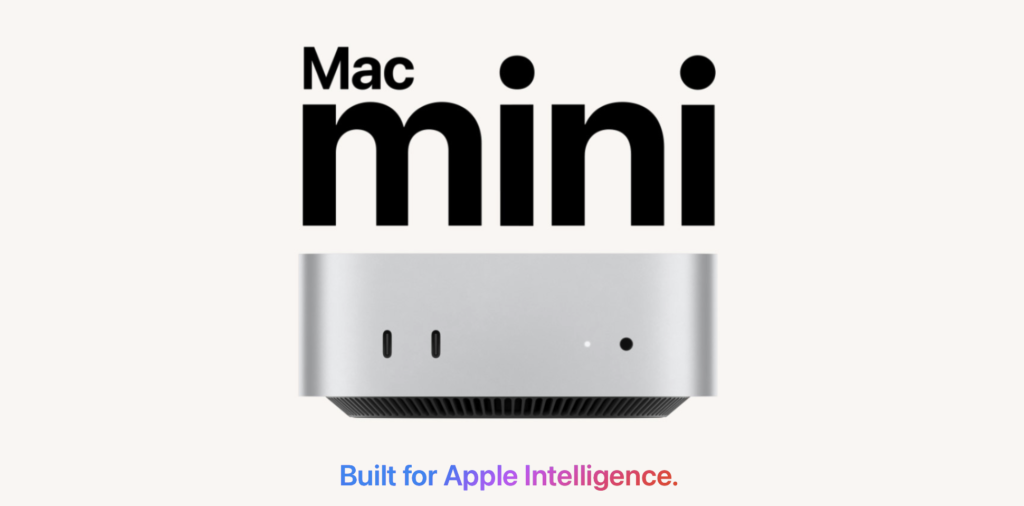
Another major factor behind the system’s popularity was power efficiency. AI workloads are often demanding and can place enormous stress on traditional desktop systems, leading to high electricity usage, loud cooling fans, and excessive heat output. The M4 Mac mini demonstrated that meaningful AI performance did not need to come at the cost of energy efficiency. Even under heavy workloads, the computer remained remarkably quiet while consuming far less power than many competing systems. This made it especially attractive for independent developers, students, small businesses, and content creators who wanted to experiment with AI tools without investing in large, power-hungry workstations.
The compact design and lower starting price of the M4 Mac mini also played an important role in its rapid adoption. Many AI enthusiasts wanted a dedicated machine for testing local AI models, running automation tasks, or experimenting with machine learning without spending thousands of dollars. The Mac mini offered a relatively accessible entry point into AI computing while still providing professional-level performance. Its small footprint allowed users to place multiple systems together for development environments, home labs, or lightweight server setups. Combined with macOS optimization and Apple’s growing AI ecosystem, the machine became appealing not only to developers but also to creative professionals using AI-assisted workflows in video editing, photography, music production, and software development.
Ultimately, the M4 Mac mini became popular with AI users because it represented a shift in how people viewed personal AI computing. Instead of requiring large, expensive systems built around massive graphics cards, Apple showed that a small desktop computer could provide impressive AI capabilities while remaining efficient, quiet, and relatively affordable. The combination of strong CPU performance, a capable Neural Engine, unified memory, and tight hardware-software integration helped the Mac mini stand out in a rapidly growing market. For many users, it became one of the most practical and approachable ways to explore the expanding world of artificial intelligence from their own desk.